
Maintenance Margin: What It Is and How It Differs from Initial Margin
Understand maintenance margin, how it differs from initial margin, and how proper margin management helps traders avoid liquidation.
Maintenance margin is the minimum level of equity a trader must maintain in their account to prevent liquidation of an open leveraged position. If account equity falls below this threshold, the exchange will issue a margin call or automatically liquidate the position.
Maintenance margin exists to:
Protect exchanges from losses
Ensure traders can cover adverse price movements
Reduce systemic risk in leveraged markets
Why Maintenance Margin Exists
Risk Control for Exchanges and Traders
Without maintenance margin, traders could accumulate losses beyond their deposited funds, exposing exchanges to counterparty risk. Maintenance margin ensures losses are capped and positions are closed before accounts turn negative.
Market Stability
Maintenance margin requirements help prevent excessive leverage, reducing the likelihood of mass liquidations during volatile market conditions.
Initial Margin vs Maintenance Margin
Understanding the difference between initial margin and maintenance margin is essential for every trader.
Initial Margin
Initial margin is the amount of capital required to open a leveraged position. It represents the upfront collateral needed to enter a trade.
Maintenance Margin
Maintenance margin is the minimum ongoing balance required to keep that position open.
Key Differences Explained
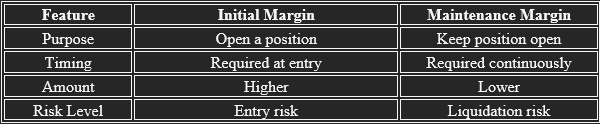
If account equity drops below maintenance margin, liquidation becomes imminent.
How Maintenance Margin Works in Trading
Equity and Margin Balance
Account equity is calculated as:
Account Balance + Unrealized PnL
When losses increase, equity decreases. Once equity reaches the maintenance margin level, the position is at risk.
Margin Call vs Liquidation
Margin Call: Warning that equity is close to maintenance margin
Liquidation: Forced closure when equity falls below maintenance margin
Some crypto exchanges skip margin calls entirely and liquidate instantly.
Maintenance Margin in Leveraged Crypto Trading
Why Crypto Traders Face Higher Margin Risk
Crypto markets are:
Highly volatile
Open 24/7
Often offer high leverage (up to 100×)
These factors make maintenance margin breaches more common in crypto trading than in traditional markets.
Maintenance Margin Ratios
Most exchanges express maintenance margin as a percentage of position size. For example:
Initial margin: 10%
Maintenance margin: 5%
As position size grows, maintenance margin requirements increase.
Example of Maintenance Margin in Practice
Long Position Example
Account Balance: $5,000
Position Size: $50,000
Initial Margin: $5,000
Maintenance Margin: $2,500
If unrealized losses reduce equity below $2,500, liquidation occurs.
Short Position Example
Position Size: $40,000
Maintenance Margin: $2,000
A sudden price spike can quickly push equity below the maintenance margin level.
Factors That Affect Maintenance Margin
Leverage Level
Higher leverage reduces the distance between current price and liquidation price, increasing maintenance margin risk.
Position Size
Larger positions require higher maintenance margin amounts.
Market Volatility
High volatility increases unrealized losses, reducing equity faster.
Fees and Funding Rates
Trading fees and funding payments reduce available margin, effectively raising maintenance margin pressure.
Maintenance Margin and Liquidation Price
Maintenance margin is directly tied to the liquidation price.
Higher maintenance margin → closer liquidation price
Lower maintenance margin → more price flexibility
Understanding this relationship helps traders place stop-loss orders safely above liquidation levels.
Cross Margin vs Isolated Margin and Maintenance Margin
Isolated Margin
Maintenance margin applies only to one position
Risk is limited to assigned margin
Preferred for beginners and risk control
Cross Margin
Maintenance margin uses entire account balance
One losing trade can drain all funds
Higher risk but more flexibility
Maintenance Margin in Algorithmic and AI Trading
In algorithmic trading and AI trading systems, maintenance margin is continuously monitored.
Professional trading bots:
Adjust leverage dynamically
Reduce exposure during volatility spikes
Close positions early to avoid liquidation
Ignoring maintenance margin can wipe out automated strategies instantly.
Common Mistakes Traders Make with Maintenance Margin
Confusing maintenance margin with initial margin
Using maximum leverage without buffer
Ignoring funding fees
Holding trades during major news events
Overestimating margin safety
These mistakes significantly increase liquidation risk.
How to Manage Maintenance Margin Effectively
Best Practices for Traders
Use conservative leverage
Keep extra margin available
Monitor equity in real time
Set stop-loss orders well above liquidation price
Avoid overexposure during volatile market conditions
Successful traders treat margin as capital protection, not free leverage.
Why Maintenance Margin Matters for Long-Term Trading Success
Maintenance margin determines how long a trader can survive unfavorable market moves. Traders who manage margin carefully:
Avoid forced liquidations
Trade more consistently
Protect psychological capital
Build sustainable strategies
Margin discipline is often the difference between professional traders and gamblers.
Maintenance margin is a foundational concept in leveraged trading. It represents the minimum equity required to keep positions open and avoid liquidation. While initial margin allows traders to enter positions, maintenance margin determines whether they can stay in the trade.
By understanding how maintenance margin works, how it differs from initial margin, and how it affects liquidation risk, traders can make smarter decisions, manage leverage responsibly, and protect their capital in volatile markets.
Mastering maintenance margin is not optional it is essential for anyone serious about crypto, futures, or margin trading.